

Smart Stadium Market Research Reveals Strong Long-Term Growth Through 2035
smart stadium market
Smart Stadium Market Size, Share and Research Report By Component (Hardware, Software, Services), By Software Solution (Digital Content and Fan Engagement
Smart Stadium Market: Revolutionizing live entertainment, this market leverages IoT and real-time data to boost fan engagement, optimize security, and streamline venue operations.”
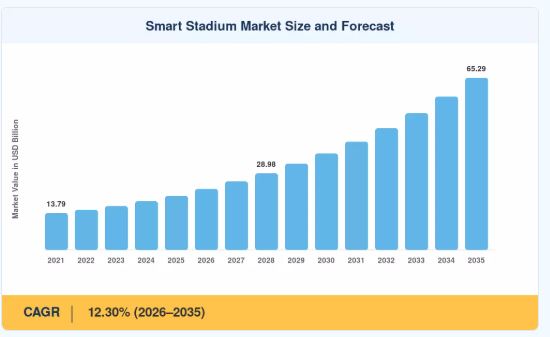
NEW YORK,, NY, UNITED STATES, July 22, 2026 /EINPresswire.com/ -- The Global smart stadium market reached an estimated USD 20.46 billion in 2025 and is projected to grow from USD 22.98 billion in 2026 to USD 65.29 billion by 2035, registering a CAGR of 12.30% during the forecast period. Two major catalysts are accelerating this trajectory: the unprecedented wave of stadium construction and renovation projects tied to FIFA World Cup 2026, the 2028 Los Angeles Olympics, and Saudi Arabia’s Vision 2030 sports investment program, alongside the rapid integration of 5G connectivity, AI-powered crowd analytics, and IoT sensor networks into venue operations. With over USD 250 billion in global sports infrastructure investment anticipated through 2035, franchise owners, venue operators, and municipal governments face mounting pressure to modernize stadium ecosystems or risk delivering substandard fan experiences to increasingly tech-savvy audiences.— Market Research Future (MRFR)
Legacy stadium infrastructure characterized by antiquated Wi-Fi networks, fragmented point-of-sale systems, and energy-inefficient lighting and HVAC installations is rapidly giving way to fully integrated smart venue platforms that unify connectivity, security, fan engagement, and operations management under a single digital backbone. A recent Deloitte Sports Business Group study estimated that top-quartile smart stadiums deploying AI-driven crowd flow management alongside cashless payment ecosystems generated 19–24% higher per-capita fan spending compared to venues still operating legacy infrastructure. This technology shift is not incremental it represents a foundational reimagining of how the global sports and entertainment industry creates value from physical venues.
Get Full PDF Sample Copy of Report: (Including Full TOC, List of Tables & Figures, Chart) @
https://www.marketresearchfuture.com/sample_request/2673
➤ How Significant Is the Smart Stadium Market’s Growth?
The smart stadium market has demonstrated exceptional and accelerating expansion, rising from approximately USD 8.43 billion in 2021 to an estimated USD 20.46 billion in 2025, representing a robust historical growth trajectory. The market is expected to nearly triple over the next decade, driven by increasing fan expectations for seamless digital experiences, surging investment in stadium-as-a-platform business models, and the proliferation of 5G-enabled IoT applications across sports and entertainment venues worldwide.
Rising demand for real-time analytics, personalized fan engagement, and data-driven revenue optimization across professional sports leagues, concert venues, and multi-purpose entertainment complexes has created acute demand for comprehensive smart stadium technology stacks. Professional sports franchises, venue management companies, sports governing bodies, and municipal governments are all investing heavily in next-generation stadium intelligence platforms to maximize revenue per event, reduce operating costs, and differentiate their venues in an increasingly competitive live entertainment landscape.
➤ What Does the Future Hold for the Smart Stadium Market?
Artificial intelligence and 5G connectivity stand at the forefront of the market’s next growth phase. AI-powered venue intelligence platforms are transforming stadiums from passive event containers into active, data-generating commercial ecosystems. Predictive crowd flow algorithms now optimize entry gate assignments, concession staffing levels, and emergency evacuation routing in real time enabling venue operators to simultaneously improve safety outcomes and fan satisfaction scores.
The growing emphasis on hyper-personalized fan experiences is another defining force shaping the market’s future. Mobile-first stadium apps enabling seat upgrades, in-seat food and beverage ordering, AR-enhanced replays, and real-time game statistics are becoming baseline expectations rather than premium differentiators. Venues deploying unified fan identity platforms integrating ticketing, loyalty, payments, and engagement data into single customer profiles are unlocking new sponsorship valuation models and dynamic pricing capabilities that fundamentally alter stadium revenue economics.
Sustainability and energy management are also redefining stadium investment priorities. With major sports organizations under intensifying ESG scrutiny, smart building management systems that optimize energy consumption, water usage, and waste management across large venue footprints are transitioning from optional upgrades to operational imperatives. AI-driven HVAC optimization, solar-integrated microgrids, and real-time carbon footprint dashboards are increasingly standard components of new stadium development briefs.
Direct Purchase this Research Report: https://www.marketresearchfuture.com/checkout?currency=one_user-USD&report_id=2673
➤ Who Are the Key Players in the Smart Stadium Market?
The smart stadium landscape is characterized by a mix of global technology conglomerates, specialized sports venue technology providers, and emerging AI-native platform companies. Key participants shaping the competitive dynamics include:
Cisco Systems — delivering stadium-grade Wi-Fi 6E and 5G private network infrastructure alongside unified venue management platforms
IBM Corporation — providing AI-powered crowd analytics, operations intelligence, and cybersecurity solutions for major sports venues globally
Ericsson — enabling 5G private network deployments and connected fan experience platforms for leading sports franchises and venue operators
Huawei Technologies — offering end-to-end smart stadium solutions integrating connectivity, video surveillance, and intelligent operations management
NEC Corporation — delivering biometric access control, AI-driven facial recognition security systems, and venue intelligence platforms
SAP SE — providing sports analytics, fan engagement applications, and stadium operations management software to elite sports organizations
Intel Corporation — supplying replay technology, AI vision processing, and immersive fan experience platforms including FreeD volumetric replay systems
Honeywell International — offering integrated building management, energy optimization, and physical security systems for large sports venues
Johnson Controls — delivering smart building automation, fire safety, and HVAC management solutions optimized for high-occupancy stadium environments
Fortinet — providing cybersecurity infrastructure protecting the converged IT/OT networks that underpin smart stadium operations
Competition in the market is intensifying as vendors race to deliver fully integrated smart venue platforms rather than point solutions, expand AI and machine learning capabilities across fan engagement and operations use cases, and establish strategic partnerships with major sports leagues, venue management companies, and construction firms. The emergence of stadium-as-a-service (StaaS) commercial models where technology vendors take revenue-share arrangements in exchange for financing infrastructure upgrades is also reshaping the competitive and commercial landscape.
➤ What Are the Emerging Trends in the Smart Stadium Market?
Several transformational trends are redefining how the smart stadium market evolves through 2035:
5G Private Network Deployment: Dedicated in-venue 5G networks are enabling ultra-low-latency fan applications, real-time IoT sensor data aggregation, and high-density connectivity for tens of thousands of simultaneous users unlocking capabilities that shared public 5G networks cannot reliably deliver in stadium environments.
AI-Driven Fan Personalization: Machine learning platforms analyzing ticketing history, in-venue behavior, concession preferences, and social media engagement are enabling venues to deliver individualized offers, seat recommendations, and content experiences at scale across entire fan bases.
Cashless and Frictionless Commerce: Stadium-wide cashless payment ecosystems integrating mobile wallets, biometric payments, and RFID wristbands are dramatically reducing transaction times, increasing per-cap spending, and eliminating cash-handling operational costs.
Augmented Reality Fan Experiences: AR overlays delivered via stadium apps and next-generation head-mounted displays are enriching in-stadium viewing with real-time player statistics, instant replay access, and interactive sponsor activations competing directly with the second-screen experience of home viewing.
Smart Security and Biometric Access: AI-powered video analytics, facial recognition entry systems, and behavioral threat detection platforms are enabling proactive security management across large crowds while simultaneously accelerating fan ingress times by up to 40%.
Sustainability and Net-Zero Venue Design: Green building certifications, solar microgrids, AI-optimized energy management, and advanced waste diversion systems are becoming standard requirements in new stadium development and major renovation projects, driven by sports governing body mandates and municipal sustainability frameworks.
Get access to the full description of the report @
https://www.marketresearchfuture.com/reports/smart-stadium-market-2673
➤ How Is the Smart Stadium Market Segmented?
The smart stadium market report provides a comprehensive segmentation framework:
1 By Technology: Connectivity & Networking (5G, Wi-Fi 6E), Video Surveillance & Security, Smart Ticketing, Digital Signage & Scoreboards, Building Management Systems, Fan Engagement Platforms
2 By Venue Type: Football & Soccer Stadiums, Basketball & Multi-Sport Arenas, Baseball Stadiums, Cricket & Rugby Grounds, Multi-Purpose Entertainment Complexes
3 By Deployment Model: New Construction, Retrofit & Renovation
4 By End User: Professional Sports Franchises, Venue Management Companies, Municipal Governments, Educational Institutions
5 By Region: North America, Europe, Asia-Pacific, Middle East & Africa, South America
➤ What Are the Regional Insights from the Smart Stadium Market?
North America commands approximately 38% of global smart stadium market share, underpinned by the concentrated spending power of the NFL, NBA, MLB, and NHL franchise ecosystems, where per-venue technology investment regularly exceeds USD 100 million. High fan expectations for premium in-venue experiences, mature 5G infrastructure from carriers willing to invest in stadium deployments, and a sophisticated network of sports technology vendors and system integrators collectively reinforce the region’s dominant position.
Europe holds the second-largest share at approximately 29%, with the United Kingdom, Germany, Spain, and France representing the primary markets. Premier League clubs, Bundesliga stadiums, and UEFA Champions League venues are setting the benchmark for smart stadium implementations, with particular emphasis on digital fan engagement, sustainable venue operations, and advanced video analytics for both fan management and sports performance applications.
Asia-Pacific represents a rapidly growing region, driven by China’s ongoing investment in world-class sports infrastructure, Japan and South Korea’s technology-forward venue development programs, and India’s surging cricket stadium modernization pipeline. The integration of mobile super-app ecosystems including WeChat Pay and Paytm into stadium commerce and fan engagement workflows is a defining characteristic of APAC smart stadium deployments.
Middle East & Africa is projected to register the highest CAGR at approximately 13.4% through 2035, fueled by Saudi Arabia’s PIF-backed sports infrastructure investment (including the 2034 FIFA World Cup hosting commitment), Qatar’s post-World Cup venue repurposing programs, and the UAE’s ongoing expansion of multi-purpose entertainment destination venues. These projects routinely specify the most advanced available smart stadium technologies from the outset of design.
South America rounds out the global picture, with Brazil and Mexico representing the most active markets for smart stadium technology procurement, supported by ongoing infrastructure investment ahead of FIFA World Cup 2030 co-hosting commitments and growing domestic sports entertainment consumption.
➤➤➤ Industry Analysis Reports by Market Research Future:
Engineering Insurance Market-
https://www.marketresearchfuture.com/reports/engineering-insurance-market-24104
Rf Amplifier Market-
https://www.marketresearchfuture.com/reports/rf-amplifier-market-24109
Financial Guarantee Market-
https://www.marketresearchfuture.com/reports/financial-guarantee-market-24117
Proximity Payment Market-
https://www.marketresearchfuture.com/reports/proximity-payment-market-24118
Robot Preventive Maintenance Market-
https://www.marketresearchfuture.com/reports/robot-preventive-maintenance-market-24120
Server Microprocessor Market-
https://www.marketresearchfuture.com/reports/server-microprocessor-market-24124
Alternative Finance Market-
https://www.marketresearchfuture.com/reports/alternative-finance-market-24302
Sound Sensor Market-
https://www.marketresearchfuture.com/reports/sound-sensor-market-24419
Esg Finance Market-
https://www.marketresearchfuture.com/reports/esg-finance-market-24428
Online Investment Platform Market-
https://www.marketresearchfuture.com/reports/online-investment-platform-market-24433
Sagar Kadam
Market Research Future
+ + +1 628-258-0071
email us here
Legal Disclaimer:
EIN Presswire provides this news content "as is" without warranty of any kind. We do not accept any responsibility or liability for the accuracy, content, images, videos, licenses, completeness, legality, or reliability of the information contained in this article. If you have any complaints or copyright issues related to this article, kindly contact the author above.
